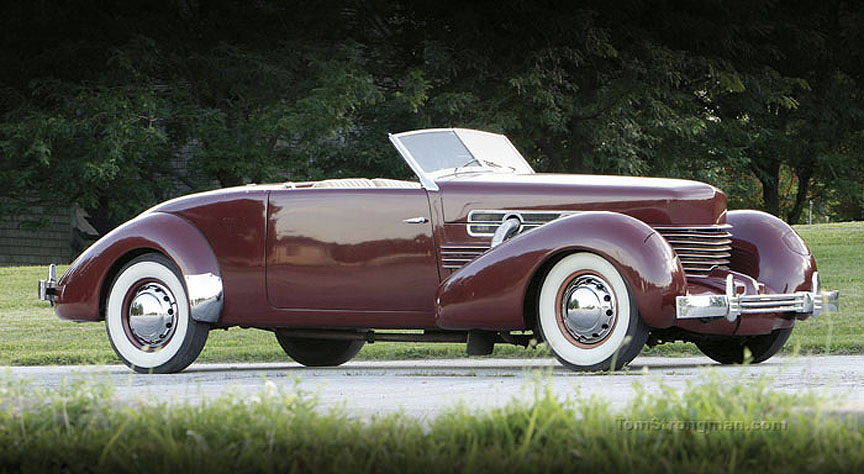
The Auto Industry of the 1930s
The 1920s were a time of prosperity for the auto industry, which was the largest and most important component of the US economy at the time. The "Big Three" companies were General Motors, Ford, and Chrysler. On average, 10% of Americans' annual income was spent on purchasing automobiles, repairing them, etc. However, when the stock market crashed in 1929, the auto industry took a huge hit. Sales dropped from 5 million cars in 1929 to 2 million in 1930, and even further to 1.33 million in 1931. Aside from the Big Three, by the end of the Great Depression, nearly all other car manufacturers were out of business.Left with 90% of the auto market, the Big Three competed with each other for supremacy in the auto industry. They experimented with more-stylish and technologically sophisticated models, while still trying to keep the selling price cheap so they could turn a profit.
As a result of reduced sales during the depression, auto manufacturers were forced to lay off much of their work force, worsening the unemployment issue. Those workers who were left working in the industry decided to unionize to protect themselves. As a part of President Roosevelt's New Deal program, he passed the National Labor Relations Act (NLRA), which guaranteed all workers the right to unionize. The United Automobile Workers used the NLRA to organize workers and to protect them from the efforts of their employers to take advantage of them. When encountered with unfair conditions, unions participated in sit-down strikes in their factories, forcing the companies to take part in collective bargaining agreements and to improve conditions for their workers.
As seen in The Grapes of Wrath, the prevalence of the used-car sales industry increased considerably during the depression, especially in the Midwest. In the Dust Bowl region and in other areas with a lack of opportunity, many families, most of which were tenant farmers, packed up what they could of their lives and moved west. Of course, they needed a means of transportation to get there, and oftentimes purchasing a used car was the cheapest option. Knowing this, car salesmen took advantage of people's desperate nature and sold low-quality cars to naive families. Vehicles were often broken down, and "repaired" in extremely cheap manners. Engine blocks would be filled with sawdust to conceal noisy transmissions and working batteries would be switched out with ones that were cracked and less reliable. Because of the demand, dealerships were able to inflate their prices to further take advantage of their desperate customers. Left with no other choice, people usually ended up buying these low quality cars in order to make their trip west.

No comments:
Post a Comment