Monday, March 24, 2014

Entry D (Ch 16-19): Family/Unity

Changing Perspectives on Family and Unity
        In Chapter 19, the Joad family's idea of family & unity has changed drastically from their prior moral values, both at the beginning of their journey and as they began to travel. In the beginning, the Joads invited people to join their family unit, like Jim Casy, for example. They openly invited people to unite with them. Over the course of their journey, though, the Joad family becomes more exclusive in terms of its membership. Previously, the Joads did everything they could to keep their family together. When their truck broke down while still traveling out to California, all of the family members stuck together, despite the suggestion to break up. (This effort to stick together was spearheaded by Ma.) The Joads felt more secure together, having all of the members of their family around, and did everything in their power to keep their family unity.

        However, in Chapter 19, the Joads leave Connie behind, who is Rose of Sharon's husband and the father of her soon-to-be-born baby:

        "Well, he ain't no good," Pa insisted. "All the time a-sayin' what he's a-gonna do. Never doin' nothin'. I didn' want to say nothin' while he's here. But now that he's run out--"...Tom broke in, "Hey, what is this? We ain't sure Connie's gone for good. We got no time for talkin'. We got to eat an' get on our way." (Pg. 272-273)

        The Joads make no effort to track down Connie, who has once again wandered off. In addition, they essentially turn on him, attacking his personality and work ethic. Instead of attempting to preserve their family unity, the Joads are content to watch their family unit break apart into even smaller pieces. The Joads are moving towards work, and go so far as to tell the shopkeeper to give Connie the wrong directions to where they're going, should he want to track them down.

        The previously compassionate, unified Joad family has shrunk in size and ultimately evolved into an exclusive group in which only the most fit members are allowed. Grandma and Grandpa have died, as they were physically weak. Jim Casy left because he took the fall for Tom Joad, and now Connie has been purposefully left behind because the rest of the family does not find him worthy to be in their company and to continue with them, using their resources up.

        As expressed in Transcendentalism, because the Joads are treating members of their family/clan in a bad manner, it is likely that karma will catch up to them and the Joads will suffer. Also, since the book is tied heavily to the Bible through Biblical Allusions, the Golden Rule is constantly in play: "Do unto others as you wish others to do unto you." By abandoning Connie, the Joads are effectively asking to be abandoned themselves in some way, shape, or form.

Tuesday, March 18, 2014

Entry C (Ch 16-19): Poetry

Poetry on Hatred
        The Californians hate the Okies and other migrants that are moving west from the region affected by the Dust Bowl and that are being driven out by industrial farming. The influx of migrants increases job competition and crowding of towns/cities. Resources are also used up more quickly. This poem is from the point-of-view of a Californian who is addressing an "Okie," expressing his discontent and hatred. This poem explains the motives for the hatred, as well as the sense of superiority that Californians feel over Okies.

Damn Okies
You come out west
from Oklahoma,
leavin' your lives behind
to start all over.
We don't care why you left, 
we just don't want you here,
taking our jobs and making our lives hard, 
you'd better steer clear.

California isn't big enough for all of us,
the depression is hitting us too,
we can barely survive where we are,
so you'd better keep on moving through.
You'll work for next-to-nothing
for a stale, old biscuit,
while we're looking for work too,
but instead we just get...
Laid off, since you'll work for less,
and now we're unemployed & stuck too,
in the same damn mess.

You see, you coming here,
isn't solving the problem.
Go back to Kansas,
and tell the other ones too.
California's for Californians,
Oklahoma's for Okies,
Don't come to my state,
Okie dokie?

**Entry E (Ch 11-15): Conflict**

The Clash Between Okies and Technology
        In the first portion of the book, the prominent struggle was between man and machine. Tenant farmers were fighting tractors and large farm corporation, which were taking over their land and kicking them out. All the tenants knew was farming, and most of them grew up on the land they lived on. To be kicked off the land they felt was rightfully theirs by some tractor that just decided to come along and do so was a huge shock, and proved to be life changing. At first, the tenants resisted the encroaching tractors, but eventually fell to the persistent force of the oncoming technology. The tractors and corporations ultimately pushed the farmers off of their land and out west. At this point in time, the type of conflict that the characters must deal with changes.

        In this section, starting on the last page of Chapter 10 and into Chapter 11, the Joad clan leaves their home and their land behind after being pushed out by the tractors and the failing economy. The conflict still remains between man and machine, but in a different way. Now, instead of being pushed out by technology, the Joads are fighting their jalopy, which constantly breaks down. Instead of fighting technology's presence, they are now fighting its effectiveness, or the lack thereof. In Chapter 12, the struggle to make it from one service station to the next is expressed.  In Chapter 13, Al is constantly monitoring the truck's engine as it drives down the road, almost in a paranoid manner--it is all that he can focus on. Throughout the section, cars and trucks break down in multiple instances, causing frustration and setbacks in the schedule of the trip.

        Another new struggle is presented in this section, which is the struggle to survive. On the road, any given family only has a small amount of money and just the possessions they were able to take with them. This leaves them vulnerable to hunger and to being taken advantage of by merchants and salesmen. Because of their desperate nature, people are eager to exploit the Okies to make a quick buck. This issue is displayed through the encounter with the car salesman in Chapter 12, where he tries to cheat the migrants. Additionally, when purchasing food, the Okies are often only able to pay a little bit of money, which limits their options and the quantity of food they are able to buy.

        Briefly, the struggle between dreams and reality is presented, starting in Chapter 12. The Joads begin to hear that California isn't big enough for everyone that's moving there. This is the first time that the Joads' utopian expectations of California are met with any sort of challenge. As the story progresses, situations and encounters add to this idea that California isn't everything that the Okies believe and hope it is.

Thursday, March 13, 2014

Entry B (Ch 11-15): Route 66


Route 66 During the 1930's
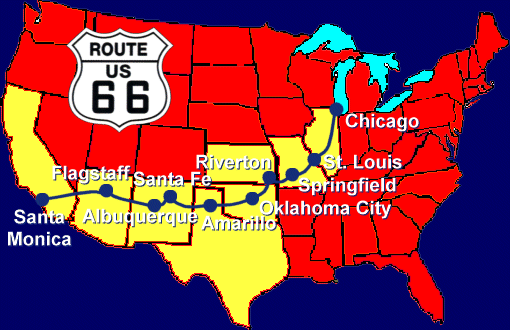
        Route 66 stretches across the United States, originating in Chicago and working its way west towards Los Angeles. In 1916, legislation was passed that created a public highway system in the United States. Route 66 was designated for construction during the summer of 1926. It's main purpose was to connect small towns in the Midwest to the nation's highway system and the rest of society, as they had previously been more or less isolated.
        Traffic on the highway increased initially because of its flat nature and the cities and towns which it passed through. These traits appealed to shipping companies, making Highway 66 a popular truck route. Also, during the 1930's, the Dust Bowl caused many families from Oklahoma, Arkansas, Kansas, and Texas to move west to California, hoping to obtain agricultural occupations. For these "Okies," Route 66 was the main thoroughfare for their westward journey. The increase in traffic helped to stimulate the economy of the small towns through which the highway passed. Small, mom-and-pop businesses began to grow, including restaurants, service stations, etc. Some of these businesses are still around today along the former route that the highway took, and are either open for business or open to tourists.
        Route 66 was similar to most other highways in the respect that it consisted of gravel and graded dirt. However, in 1938, it became the first highway in the United States to become fully paved. Although safe in most places, some dangerous sections contained hairpin turns and were nicknamed "Bloody 66." Many gruesome accidents occurred on these stretches, and eventually most areas of risk were improved to be less dangerous.
        Route 66 provided migrants, such as the Joads, with an easy way to move west. Once on the highway, one did not need to do anything else besides continue driving on the highway--no further directions were needed to reach their destination on the West Coast. Without the highway, relocation westward would have been much more confusing and surely less appealing. By sharing a common path of travel, migrants were able to help each other if their cars broke down, or if they needed general assistance. The bottom line is, Route 66 was crucial to the Okies who were escaping the Dust Bowl during the 1930's.

Friday, March 7, 2014

**Entry I (Ch 1-10): Biblical Allusions**

Biblical Allusions
        Biblical allusions are quite common throughout The Grapes of Wrath. There have already been many of them through chapter 10:

  • When Tom Joad takes off his shoes and walk from the highway towards the tree and connects himself to the land, this represents the 40 days that Jesus spent in the desert, contemplating his life and becoming closer to God, his father.
  • Tom's encounter with Rev. Jim Casy at the tree after taking a long journey to get there parallels Moses' trip up Mt. Sinai, where he encounters God in the form of the burning bush. Casy shares his new religious principles after having been fed up with traditional religion. Similarly, God delivers the 10 Commandments to Moses, after the Jews had been straying from God, spelling out the new rules he has for them.
  • Jim Casy's initials are JC, which also stands for Jesus Christ.
  • The Dust Bowl and Great Depression represent the Great Flood.
  • Throughout the novel, a snake keeps showing up. In the book of Creation, Adam and Eve are tempted by a snake/serpent, who represents Satan, the devil.
  • The Joad family's trip west in a truck parallels Noah and his ark.
  • The 12 people, plus Rev. Jim Casy, who travel west and leave everything behind alludes to Jesus and his 12 disciples, whom Jesus chose to spread his word, and leave all of their lives and possessions behind.

        These connections are significant, because they help to tie a sense of purpose to certain events that take place in the plot. They also help to convey the type of story this is, one that is guided by the Bible, where most of the events are similar to those which take place in it. With a similar plot taking place in the Bible, one can predict the outcome of things that are happening, future events, and undisclosed information about certain characters if they are able to pick up on the allusions that are being presented. For example, the Dust Bowl is represented by the Great Flood. The flood eventually ends, and those who God wanted to save ultimately stayed alive. Thus, one can predict that the Great Depression and the Dust Bowl will eventually end, and those who attempted to restore their lives will be successful. Also, since Tom encountered Casy at the tree, acting in the role of Moses, one can conclude that Tom will eventually help to spread Casy's new philosophy, as Moses did with the word of God.

No additional sources, knowledge taken from my study of the Bible as a Catholic.

Entry H (Ch 1-10): Repetition of "New" and "Cheap"

Repetition of "New" and "Cheap"
        "The man's clothes were new--all of them, cheap and new. His gray cap was so new that the visor was still stiff and the button still on, not shapeless and bulged as it would be when it had served for a while all the various purposes of a cap--carrying sack, towel, handkerchief. His suit was of cheap gray hardcloth so new that there were creases in the trousers...He wore a pair of new tan shoes of the kind called "army last," hobnailed and with half-circles like horseshoes to protect the edges of the heels from wear." (6)

        In writing this passage, and in many other passages in The Grapes of Wrath, John Steinbeck repeats a particular word or phrase many times. In this case, the repetition helps to emphasize the degree to which the clothes are new and cheap. Because of the repetition, it becomes obvious that Tom Joad's clothes are brand new, almost as new as they can possibly be. When visualizing this passage, the description becomes so much more vivid, knowing that the suit was still creased from being so new. One can now envision the crispness of the suit, and possibly even stimulate some olfactory sensations, smelling the smell that a fresh-off-the-rack suit has.

        The repetition of such vocabulary also suggests its prevalence, perhaps not just in one's clothes, but in the culture of the time. In a period such as the Great Depression, one is forced to live with less available money. Therefore, cheap is usually the only way to go about purchasing new items. Also, having new items is a novelty--it doesn't happen very often. The repetition of the word in the description of Tom Joad's clothes suggests his excitement for possessing new items despite the time of such hardship. Having new items is often the little spark that is needed to push one to keep on going through tough times, providing a sense of hope for the future.

Thursday, March 6, 2014

Entry D (Ch 1-10): The Auto Industry of the 1930s


The Auto Industry of the 1930s
        The 1920s were a time of prosperity for the auto industry, which was the largest and most important component of the US economy at the time. The "Big Three" companies were General Motors, Ford, and Chrysler. On average, 10% of Americans' annual income was spent on purchasing automobiles, repairing them, etc. However, when the stock market crashed in 1929, the auto industry took a huge hit. Sales dropped from 5 million cars in 1929 to 2 million in 1930, and even further to 1.33 million in 1931.  Aside from the Big Three, by the end of the Great Depression, nearly all other car manufacturers were out of business.

        Left with 90% of the auto market, the Big Three competed with each other for supremacy in the auto industry. They experimented with more-stylish and technologically sophisticated models, while still trying to keep the selling price cheap so they could turn a profit.

        As a result of reduced sales during the depression, auto manufacturers were forced to lay off much of their work force, worsening the unemployment issue. Those workers who were left working in the industry decided to unionize to protect themselves. As a part of President Roosevelt's New Deal program, he passed the National Labor Relations Act (NLRA), which guaranteed all workers the right to unionize. The United Automobile Workers used the NLRA to organize workers and to protect them from the efforts of their employers to take advantage of them. When encountered with unfair conditions, unions participated in sit-down strikes in their factories, forcing the companies to take part in collective bargaining agreements and to improve conditions for their workers.

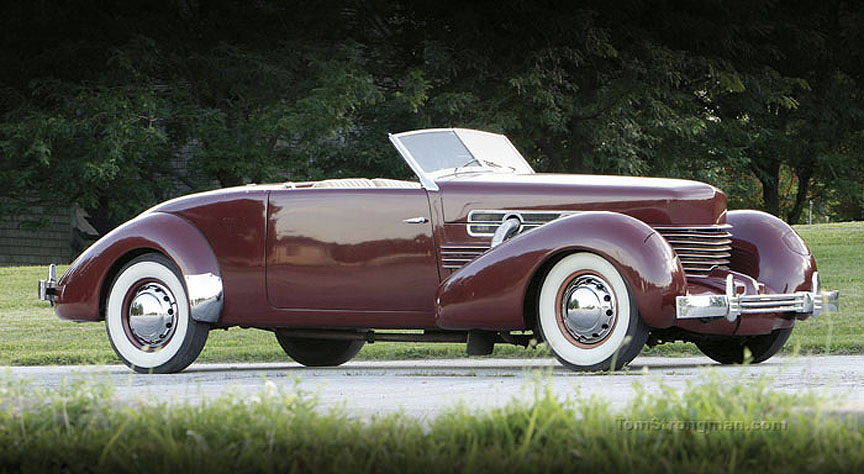
        As seen in The Grapes of Wrath, the prevalence of the used-car sales industry increased considerably during the depression, especially in the Midwest. In the Dust Bowl region and in other areas with a lack of opportunity, many families, most of which were tenant farmers, packed up what they could of their lives and moved west. Of course, they needed a means of transportation to get there, and oftentimes purchasing a used car was the cheapest option. Knowing this, car salesmen took advantage of people's desperate nature and sold low-quality cars to naive families. Vehicles were often broken down, and "repaired" in extremely cheap manners. Engine blocks would be filled with sawdust to conceal noisy transmissions and working batteries would be switched out with ones that were cracked and less reliable. Because of the demand, dealerships were able to inflate their prices to further take advantage of their desperate customers. Left with no other choice, people usually ended up buying these low quality cars in order to make their trip west.

Monday, March 3, 2014

**Entry A (Ch 1-10): Causes of the Great Depression & the Stock Market Crash**


Causes of the Great Depression & the Stock Market Crash
        The stock market in the United States crashed on October 29th, 1929, on what would become known as "Black Tuesday." In the months and years leading up to this tragic day, the prices of stock increased exponentially, as seen in the diagram above. Despite this apparent prosperity, analysts predicted that the stock market would inevitably crash at some point. However, nobody could possibly have imagined how severe the consequences of such a crash would be, in its creation of the infamous Great Depression.

        Although the Great Depression consisted of more than the stock market crash, this event caused the domino effect that would cripple the nation. The crash can be attributed to stock market speculation, where investors and average people guessed and gambled, purchasing stock in companies they knew little or nothing about. This caused the prices of stock for a given company to dramatically increase, even though it didn't reflect the company's true value. Additionally, most investors relied on the practice of buying on margin to finance their investments, where a person pays approximately 10% of the stock's price on a down payment, then pays for the rest using loans. The loans go unpaid until the person decides to sell their stock for a higher price, allowing them to repay the loan and make a significant profit for themselves. This practice worked incredibly well for a long duration of time. However, when stock values naturally decreased a little bit in early 1929, people began freaking out and selling their stock. As a result, stock prices fell even further and bank loans weren't able to be repaid, which caused banks to fail entirely.

        The crash and its long term effects were allowed to happen because of several mistakes by the Federal Reserve Board. Leading up to 1929, it was extremely easy to take out a loan; consequently, speculation was just as easy to take part in. After the crash, the FRB recognized this problem, and decided to make it much more difficult to obtain a loan, employing a tight-money policy in 1930 & 1931. To do so, interest rates on loans were brought up (to discourage large loans) and the amount of currency in circulation was reduced. Instead of resolving the problem at hand, these actions by the FRB actually made the situation worse, because the lack of available money prevented any sort of recovery from taking place.

        In 1930, the US government passed the Hawley-Smoot Tariff Act, which substantially raised tariffs on agricultural and manufactured goods that were imported to the US. The intention was to aid ailing American businesses by reducing their competition with international companies and their products. Theoredically, this tactic should have worked, because the added tariff would increase the prices of foreign goods, making American products the cheapest option. Yet, instead of fixing the problem, these efforts were nullified when other countries simply raised their import duties on American products, which reduced US exports to Europe.

        The last major cause of the Great Depression was the maldistribution of wealth in American society. The gap between rich and poor was greatly expanded in the 1920s as a result of Republican political policy. Taxes on the wealthy were low and unions were discouraged (lower wages). The problem with having so much wealth concentrated in the wealthy classes is that the wealthy don't spend as much money as middle class citizens do towards stimulating the economy. Also, unemployed workers can't purchase and consume products that are being made, reducing demand, and causing layoffs and unemployment.

        The Great Depression had a direct effect on the Joad family. When Tom returns to his family's home after he is released from prison on parole, his family has moved, in the process of moving west. Desperate to remain financially sound in the face of recession, many landowners kicked out their tenant farmers and replaced them with tractors, as is the case with the Joad family and their neighbors. Maintaining a tractor is much cheaper than paying dozens of tenants, and oftentimes was more efficient in terms of labor completion. Therefore, many tenant farmers and their families were forced out onto the streets to fend for themselves during the largest recession in the history of the United States.

        Additional Sources: Murrin, John M. "The Great Depression and the New Deal, 1929-1939." Liberty, Equality, Power: A History of the American People. Australia: Wadsworth Cengage Learning, 2012. 690-91. Print.